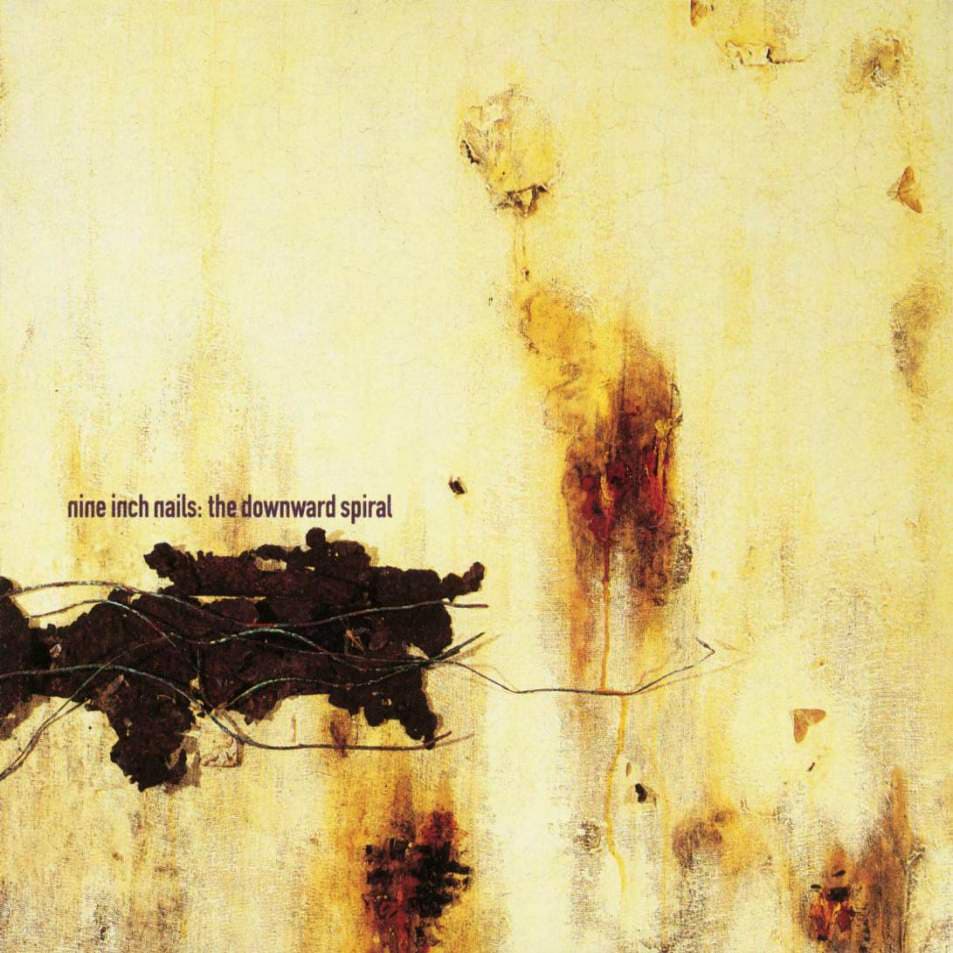
The Downward Spiral was recorded primarily at Le Pig studio, a home studio Trent Reznor set up in the rented house at 10050 Cielo Drive in Beverly Hills, the former residence where the Sharon Tate murders took place in 1969. The album was produced by Trent Reznor alongside Flood, the renowned British producer known for his work with Depeche Mode and U2, and was released on March 8, 1994, on Nothing Records via Interscope. The recording process blended analog and digital techniques extensively, layering industrial textures through heavy use of samplers, synthesizers, tape manipulation, and deliberate sonic degradation alongside live instrumentation. Engineer Alan Moulder mixed much of the album, contributing to its dense, meticulously crafted sound that alternated between extreme abrasion and fragile minimalism. The album's production was notable for its conceptual approach as a continuous narrative exploring self-destruction, with Reznor spending nearly two years obsessively crafting and layering sounds to achieve a level of detail that became a benchmark for industrial rock production.
Digisko uses an anonymous analytics cookie (Google Analytics) to understand which albums and pressings get the most attention. No tracking until you accept.
Releases
29 cataloged · sorted by audiophile score
Sign in to add releases to your collection and vote for the best edition.
1994 · USVinylOriginal pressing
Interscope Records — PR 5509 · Nothing Records — PR 5509 · TVT Records — PR 5509 · Interscope Records — STPR 5509 · Nothing Records — STPR 5509 · TVT Records — STPR 5509
8/10
0 analog
The original 1994 US vinyl pressing is highly coveted on SHF and among collectors; considered one of the best-sounding versions of the album with excellent dynamics and widely regarded as the definitive vinyl edition.
Interscope Records — UIGY-7066 · Interscope Records — UIGY-7067
8/10
0 digital
The Japanese SACD is highly praised on SHF as one of the best-sounding versions of this album, with the DSD layer offering superior dynamics and detail over all CD pressings.
Chronicles — B0003739-36 · Interscope Records — B0003739-36
7/10
1 digital
The US hybrid SACD is frequently recommended on SHF as the best widely available version; the SACD layer is considered excellent and the CD layer is also an improvement over the original pressing.
Interscope Records — B0025683-01 · Nothing Records — B0025683-01 · Interscope Records — B0025683-01ST02 · Nothing Records — B0025683-01ST02
7/10
0 analog
The 2017 Definitive Edition vinyl reissue is generally well-regarded on SHF as a solid remaster, though some prefer the original 1994 pressing for its rawness.
Atlantic — 92346-2 · Interscope Records — 92346-2 · TVT Records — 92346-2
6/10
0 digital
The original 1994 US CD pressing is the baseline reference on SHF; respected as the original Alan Moulder master and preferred by some purists over later remasters, though the SACD editions are generally considered sonically superior.
The 2008 vinyl reissue is frequently discussed on SHF and generally considered a good pressing, though opinions are split on whether it matches the original 1994 vinyl.
Japanese SHM-CD edition is discussed positively on SHF; some members feel the SHM-CD format provides a marginal improvement in clarity, though others consider the SACD releases superior.
Original Japanese pressing on EastWest is occasionally praised on SHF for clean manufacturing quality typical of Japanese CDs; some consider it a worthy alternative to the US pressing.
UK Island pressing is considered a solid alternative to the US pressing; some SHF members note slightly different sonic character but no dramatic improvement.
DualDisc release with the DVD-Audio side being more interesting to audiophiles; the CD layer is considered decent but the SACD release from the same era is preferred.